
Being willing to have difficult conversations
Why those fighting against BigTech need to get comfortable arguing about issues involving disabled

Arguments from disability are going to be some of the hardest to respond to, for those of us arguing for measures to protect children from BigTech, such as age restricting social media.
I mean, who wants to be ‘that guy’?! The one who says, to someone such as Ezra Sholl (pictured in Guardian article), your situation is obviously so difficult and the stories you share, of interacting with sports and film, so affecting, yet, despite this, I think age restricting social media is the right thing to do.
Who wants to be the one who says to the visually impaired (another disability highlighted in recent weeks), I see the massive benefits that AI powered glasses might give you, but I still think they should be banned?
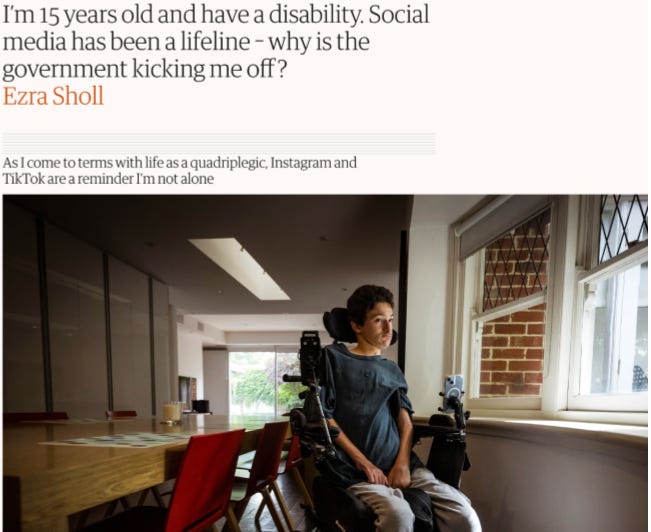
I certainly don’t.
But I will.
Here goes, I’ll make two points.
First, as Ezra makes clear in the article, referring to the hate speech and bullying he receives on social media, BigTech companies such as Snap and TikTok can be the most disgusting of places and they have steadfastly refused to clean up their act. Worse, as details emerge, such as in the lawsuits against Meta, these firms have known for years the harm being done and, in at least some cases, suppressed it!
They have been given numerous warnings and have refused to act, continuing to harm children on an industrial scale, as they do, right now, today. Enough is enough, we must legislate. We must age-gate these products.
Second, there has to be another way. Surely, there has to be a way that allows young people, such as Ezra, to enjoy some of the pleasures of online communities, without the X-Insta-Threads hellscape that children are currently subjected to? I have read before of the huge mistake made when BigTech corporations were allowed to seize the public sphere in the way that they have, and to then turn it into a monetized casino of unregulated eyeballs, attention, rage and abuse.
I have read that non-profits, for example, could be supported in creating alternative communication platforms that put ethics and fairness at their heart. This doesn’t seem such a crazy proposition.
……
At heart, I think the arguments from disability, from inclusion, are often false choices. They say ‘Accept the current reality (and this new even worse one about to be foisted on you) or you will be the bastard who harms those less fortunate than you’.
I believe there is a third way, that allows us to regulate, to innovate, and recapture the very best of our societies whilst integrating technology that is purposeful and life affirming and supports those less fortunate. It will be a bit slower, a bit more expensive, perhaps, but it will be better, so much better.
I believe the route that takes us there, despite the harms that may initially be felt by some, will come from saying ‘NO’ to these out of control, unaccountable BigTech corporations.
So, I’ll be that guy.
www.setat16.org
I am making a presentation for a team of athletes from Special Olympics -Kenya.
This subtract has just entrenched my faith in our course and a more reason to confront this sensitive yet most unexplored relation between tech and differently abled communities.
Thank you for your consistency and passion.
HI Gary, thanks for the article and the link to Set at 16....(lovely) Speaking of disability though, as long as telecommunications companies (and military and surveillance interests) continue to deny the non-thermal effects of non-ionizing radiation, the number of children and adults who are experiencing increased oxidative stress and direct neurological harm, including disability, autism, ADHD, etc. will continue to grow. This is another one of those difficult conversations...